
Executive summary. Core clinical takeaways.
Malaysian clinic patients communicate using natural code-switching—mixing English, Bahasa Melayu, Chinese dialects, and Manglish particles like "lah", "kan", and "bleh x".
Generic global chatbots fail in Malaysia because they expect single-language inputs and force users through awkward "Select 1 for English, 2 for BM" menus.
An intelligent multilingual AI receptionist dynamically detects patient language and tone in real time without manual selection menus.
Conversational agents understand informal clinic shorthand (e.g. "nak check demam", "flu jab ada?", "slot kul 3 ptg") while maintaining professional clinical boundaries and dignity.
LamaniHub equips Malaysian clinics with an AI front desk layer that coordinates multilingual WhatsApp bookings and reminders while staff maintain full oversight.
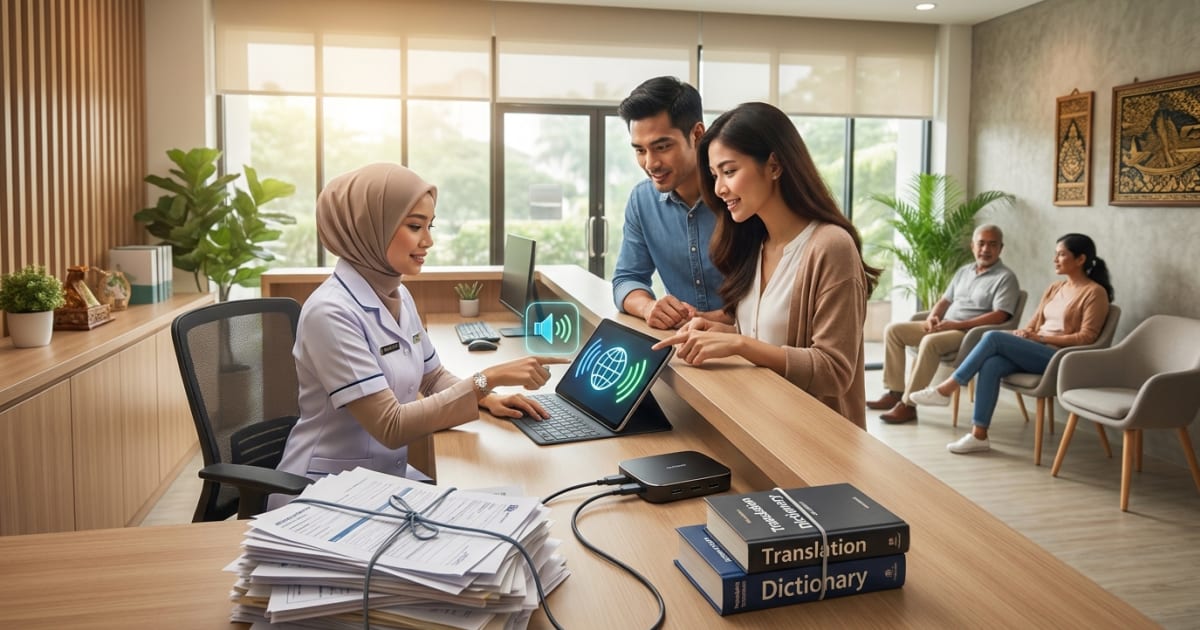
Malaysian private clinics operate in one of the most linguistically diverse healthcare landscapes in Southeast Asia. On any given morning, your front-desk WhatsApp inbox receives inquiries ranging from formal English and colloquial Bahasa Melayu to Manglish abbreviations and multilingual voice messages. Deploying a generic, foreign chatbot often alienates patients with rigid "Press 1 for English" menus. A localized setup pairing an AI receptionist for clinics with live scheduling solves this problem by understanding everyday Malaysian communication patterns.
The Unique Linguistic Challenge of Malaysian Clinic Reception
When patients reach out to book a doctor consultation or check clinic hours, they rarely communicate in textbook grammar. Instead, front desks routinely handle rapid, conversational shorthand:
- "Hi doc, esok pagi got slot for child vaccination tak?"
- "Nak book appointment for my dad, check bp and refill ubat."
- "Buka sampai kul brape arini? Got walk in queue?"
- "Can I book cleaning session this Saturday 11am Dr Wong?"
For a human receptionist raised in Malaysia, these messages are effortless to interpret. But traditional software and rigid rule-based bots stumble immediately. When an automated system fails to parse informal syntax or treats colloquial words as errors, patients get frustrated and call the clinic or walk away to a competing practice nearby.
Code-Switching: Handling Bahasa Melayu, English, and Colloquial Phrasing
Code-switching—the fluid movement between two or more languages in a single sentence—is central to everyday Malaysian dialogue. A patient might begin with English politeness, insert a Bahasa Melayu timing expression, and end with a local rhetorical particle like "kan" or "lah".
An intelligent clinic AI agent powered by modern Large Language Models (LLMs) does not look for rigid keyword matches. Instead, it extracts semantic meaning:
- Intent identification: Distinguishing booking requests from general pricing inquiries or clinic location checks.
- Temporal entity extraction: Correctly parsing expressions like "esok kul 3 ptg" (tomorrow at 3:00 PM), "this coming wed", or "lusa pagi" into standard calendar timestamps.
- Shorthand comprehension: Decoding common clinic messaging acronyms (e.g. "tq doc", "bleh x", "appt", "doc tan ada x") without throwing error loops.
By interpreting intent within local conversational context, the AI receptionist verifies available practitioner slots and confirms bookings without demanding that the patient rewrite their request.
Maintaining Clinical Dignity While Speaking the Patient's Language
While the AI must understand colloquial and informal patient messages, clinic communication must remain respectful, reassuring, and professional. Striking the balance between warmth and healthcare dignity is essential:
- Mirroring comfort without excessive slang: If a patient writes in Bahasa Melayu, the AI responds in clear, polite BM (e.g. "Terima kasih atas mesej anda. Slot bersama Dr. Aiman pada jam 3:00 petang esok masih tersedia..."). It does not mimic heavy slang, preserving professional trust.
- Healthcare compliance (KKLIU-safe): The AI strictly handles administrative coordination—scheduling, operating hours, preparation reminders, and clinic location. It never diagnoses symptoms, dispenses treatment recommendations, or guarantees clinical outcomes.
- Human escalation triggers: When messages indicate potential emergencies or complex clinical histories, the system politely advises immediate medical attention and flags the conversation for priority front-desk staff takeover.
Instant Language Detection Without Manual Selection Menus
One of the quickest ways to increase abandonment in healthcare messaging is forcing patients to navigate a phone-tree style greeting:
"Welcome. For English, type 1. Untuk Bahasa Melayu, sila tekan 2. 华语请按 3."
Modern patients expect immediate responsiveness. When someone sends a WhatsApp message, they want an answer to their specific question right away.
A multilingual AI front desk evaluates the opening message, detects the dominant language and tone, and responds naturally in that exact linguistic mode. If a senior patient messages in BM, the dialogue proceeds seamlessly in BM. If a young professional continues in English, the system maintains fluent English. This zero-click language adaptation dramatically reduces drop-offs and preserves a boutique, personalized patient experience.
How Front Desks Maintain Full Oversight
Automating WhatsApp booking does not mean leaving your clinic operations unmonitored. Front-desk team members access a unified inbox where every conversation is visible in real time:
- Seamless staff takeover: Receptionists can pause AI automation on any individual chat with a single click whenever a patient requires personal assistance.
- Calendar synchronization: Confirmed appointment slots immediately block availability in your clinic's scheduling view, preventing walk-in or telephone double-bookings.
- Automated multilingual reminders: In the 24 hours leading up to an appointment, the system sends confirmation and preparation reminders in the patient's preferred language, reducing costly no-show rates.
By bridging the gap between local language habits and operational scheduling rigor, Malaysian clinics turn chaotic after-hours WhatsApp messages into organized, confirmed bookings—freeing front-desk staff to focus on warm in-person patient care.
Frequently asked. Clear operational answers.
Understand how LamaniHub fits into your clinic's existing phone lines, web presence, and appointment policies.
Does the AI mix up medical terms in Malay? ↓
No. The AI receptionist is trained on local healthcare context and clinical boundaries. Common local phrases such as "nak check darah tinggi", "cuci luka", or "demam batuk" are accurately mapped to the right appointment consultation categories without diagnosing or altering medical terms.
Can staff take over in their preferred language? ↓
Yes. The clinic team can view full WhatsApp conversation histories in the shared inbox and jump in at any time. When a staff member replies in English, BM, or Chinese, the AI steps back gracefully and lets human front-desk team members handle custom inquiries.
How does the AI handle patients who switch languages mid-conversation? ↓
Patients often greet in English ("Hi morning") and switch to BM or Manglish to describe their request ("nak slot esok ptg bleh?"). Large language model receptionists detect code-switching per message turn, responding coherently in the patient's dominant phrasing rather than resetting the flow.
Does the multilingual AI replace our current clinic management system? ↓
No. LamaniHub is not a clinic management system (CMS) or electronic medical record (EMR). It serves as an intelligent front-desk WhatsApp communication and booking layer that syncs appointments with your team without replacing your existing medical record software.
Explore the complete LamaniHub platform
Booking flow is just one pillar. Discover how our AI receptionist, calendar synchronization, and automated follow-ups unite into one clinical front desk engine.