
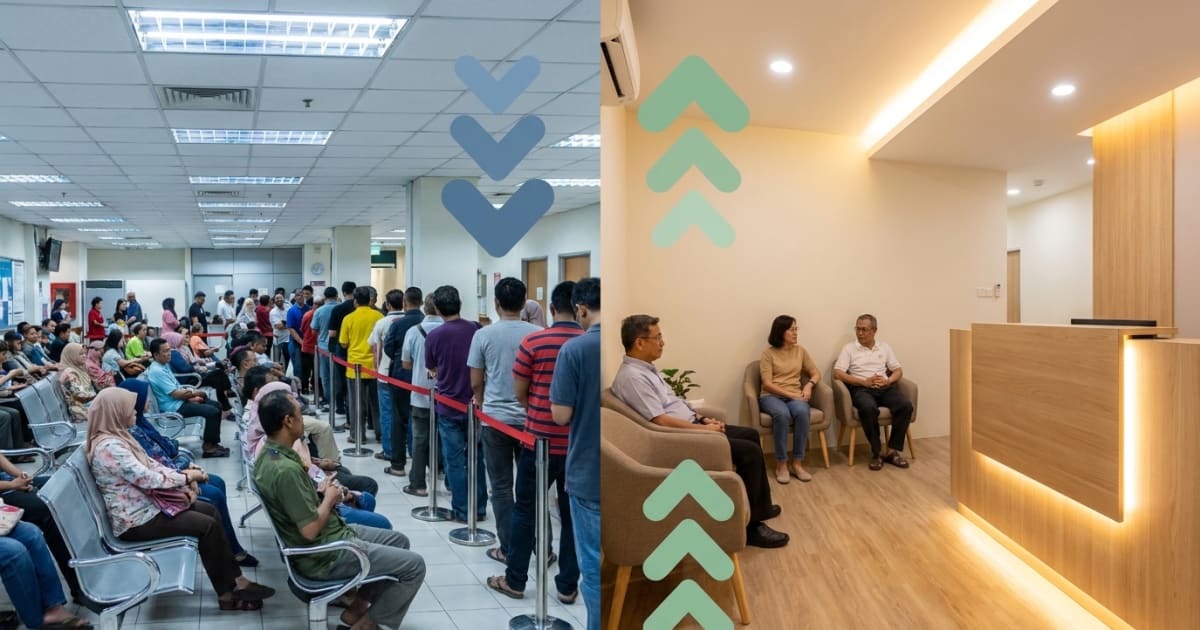
Executive summary. Core clinical takeaways.
Hospitals often have larger systems, but private clinics can usually move faster on the parts of the patient journey that matter most before the visit: booking, confirmation, reminders, and convenience.
Patients often choose private clinics for speed, clarity, and lower friction, so digital booking can become a real competitive advantage.
Most private clinics do not need hospital-scale software to improve the patient experience. They need a clean front-of-house workflow that reduces manual coordination.
LamaniHub is positioned around exactly that workflow: online booking, WhatsApp reminders, patient CRM, and schedule coordination for Malaysian clinics.
When people compare clinics and hospitals, they often assume hospitals will always be more digitally advanced. In some areas that may be true. But in the patient journey before the visit, private clinics often have a distinct operational advantage: they can deploy practical front-of-house workflows significantly faster without navigating complex IT committee approvals.
Pairing modern digital booking with an always-on front desk is the fastest way for a private practice to protect its lead. Explore our AI receptionist for clinics hub for automated WhatsApp enquiry response, slot confirmation, and after-hours intake workflows (designed specifically for appointment coordination, not heavy EMR replacement).
That matters because many patients are not judging convenience based on enterprise complexity or hospital infrastructure. They are judging it based on simple, immediate friction points: Can I book online easily? Will I get timely WhatsApp reminders? Will the clinic respond after hours? Will my visit feel organized?
A robust clinic appointment system in Malaysia is not about replicating bloated hospital-grade IT suites. It is about streamlining the front-of-house workflow with clinic-focused online booking, automated WhatsApp reminders, and integrated patient coordination tools.
Why are patients increasingly choosing private clinics for speed and convenience?
Patients regularly choose private clinics over larger medical centers because they want a frictionless path to care. In outpatient healthcare, the clinic wins not by having the largest facility, but by offering the smoothest scheduling experience.
- immediate appointment access without navigating phone trees or portal logins
- shorter, direct communication loops via WhatsApp
- clear expectations regarding wait times and clinic availability
- frictionless rescheduling and automated attendance reminders
- a personal, attentive front-desk touchpoint
This is where focused digital operations make the difference. If a private clinic still relies on scattered manual WhatsApp chats, paper logbooks, and staff memory, it forfeits the natural convenience advantage that private care should deliver.
What do hospitals have, and what do private clinics actually need?
Hospitals operate large enterprise hospital information systems (HIS), complex department routing, and multi-tier governance. Private clinics face a much more focused operational objective: converting patient demand into confirmed appointments with zero front-desk friction.
Private clinics do not need heavy enterprise complexity. They need clarity, speed, and reliability in the pre-visit booking journey.
A private clinic can transform its patient experience without deploying cumbersome software suites. The highest-impact improvements focus strictly on the pre-visit front-desk layer.
The digital gap: where private clinics outperform hospital systems
By focusing on front-of-house speed rather than back-office bureaucracy, independent practices and specialist clinics can move faster across three core areas:
1. Rapid online booking deployment
Private clinics can launch a streamlined booking page, configure consultation slots, and publish a frictionless scheduling flow in days, bypassing the lengthy procurement and compliance cycles typical of hospital IT departments.
2. Consistent, automated WhatsApp reminders
Reminder protocols are straightforward to standardize in a private practice. Implementing automated WhatsApp reminders provides direct show-up protection and slashes avoidable no-shows without adding admin overhead.
3. Personalized patient coordination
Private clinics excel at pairing digital efficiency with warm human service. Front-desk staff can leverage organized patient CRM records to deliver personalized attention without getting bogged down by manual data entry.
How an AI after-hours receptionist gives private clinics a competitive edge
Over 40% of outpatient healthcare booking enquiries in Malaysia occur after clinic operating hours—during evenings, weekends, and public holidays. Hospitals often handle this with generic call centers or rigid portal registration forms with high drop-off rates.
Private clinics can capture this demand instantly using an AI receptionist for clinics. Operating directly within WhatsApp, the AI answers common patient questions (services, location, hours, parking), presents live doctor availability, and secures confirmed bookings 24/7 without requiring manual staff intervention.
Positioning the appointment layer: why private clinics don't need full EMR overhauls
Many clinic owners mistakenly believe that improving digital booking requires replacing their existing Clinic Management System (CMS) or Electronic Medical Records (EMR). This misconception often causes analysis paralysis and stalls operational upgrades.
In reality, patient convenience lives entirely in the appointment layer—the front-of-house touchpoints that happen before clinical consultation. LamaniHub sits cleanly at this front-facing layer, managing online booking, WhatsApp AI triage, automated confirmations, and schedule coordination while letting clinical staff continue using whatever clinical or billing records they prefer.
Which three digital tools give private clinics the biggest advantage?
Rather than adopting multiple disjointed platforms, Malaysian private clinics achieve maximum ROI by unifying three pre-visit capabilities:
- Frictionless online booking: allowing patients to reserve slots directly from Google Business Profile, social media bios, or website links.
- WhatsApp appointment reminders & confirmations: protecting clinical calendars by securing patient commitments and enabling one-click confirmations.
- Patient context CRM: giving reception teams immediate visibility into booking history, communication logs, and patient preferences.
What happens when a private clinic delays front-desk digitization?
Clinics that rely purely on manual front-desk processes often suffer hidden operational leaks:
- delayed WhatsApp replies cause prospective patients to book with competing clinics
- reception staff spend hours answering repetitive scheduling questions instead of attending to in-clinic patients
- unconfirmed appointments result in empty consultation slots and unpredictable provider schedules
- after-hours enquiries go uncaptured until the next business day
Actionable steps: upgrading your clinic's booking workflow this week
- Audit your current patient intake touchpoints (website, WhatsApp, Google Business Profile).
- Set up clear appointment types, consultation durations, and provider scheduling rules.
- Deploy a dedicated online booking page tailored for mobile users.
- Automate 24-hour and 2-hour WhatsApp reminder sequences.
- Activate 24/7 after-hours WhatsApp auto-reply to capture evening and weekend enquiries.
How LamaniHub empowers private clinics across Malaysia
LamaniHub provides the dedicated front-of-house engine Malaysian private clinics need to deliver a modern, hospital-beating patient experience:
- instant online booking to eliminate scheduling phone tags and message delays
- smart WhatsApp reminders to protect schedules and minimize no-shows
- AI-driven after-hours response to capture patient enquiries around the clock
- unified front-desk schedule views that support both digital bookings and walk-in patients
To see how LamaniHub can streamline your front-of-house workflow, explore How It Works, view our Features, or check Pricing.
Conclusion: compete on patient convenience, not IT complexity
Hospitals may maintain enterprise IT infrastructure, but Malaysian private clinics possess the agility to deliver faster, more responsive patient journeys.
By streamlining online booking, automating WhatsApp touchpoints, and activating 24/7 front-desk support, private practices can establish a lasting competitive edge rooted in what modern patients value most: speed, clarity, and exceptional convenience.
Frequently asked. Clear operational answers.
Understand how LamaniHub fits into your clinic's existing phone lines, web presence, and appointment policies.
Why can private clinics move faster than hospitals digitally? ↓
Because private clinics usually have fewer layers of approval, simpler service structures, and a more direct link between operational improvement and revenue. That makes it easier to launch practical tools like online booking and reminder workflows quickly.
Do private clinics need the same systems that hospitals use? ↓
Usually not. Hospitals may need deeper enterprise systems across many departments, while private clinics often benefit more from a focused appointment workflow that improves booking speed, reminder consistency, and front-desk coordination.
What digital tools matter most for a private clinic before the visit? ↓
The highest-impact tools are usually online booking, automated WhatsApp reminders, and a patient CRM that keeps booking history and follow-up context visible for the team.
Can a private clinic still handle walk-ins while offering digital booking? ↓
Yes. LamaniHub's positioning already supports clinics that need both online bookings and manual entries in one schedule view, which is useful for clinics that want to improve convenience without abandoning walk-in flexibility.
Explore the complete LamaniHub platform
Booking flow is just one pillar. Discover how our AI receptionist, calendar synchronization, and automated follow-ups unite into one clinical front desk engine.